
AI without the fumbling. Workshops for your team.
Two workshops in plain Hebrew. Your team learns to work with AI the way you work with a partner, and leaves with something to do tomorrow.
Pick a workshop, send it, and I get back to you with an answer.
Two workshops, depending on where your team stands
90 minutes each. One for teams at any level, one for teams already working with AI who want to level up.
AI Without the Fumbling
Who it's for:Teams at any level, from people just starting out to people who use it every day. No technical background needed.
After the workshop, you:
- Write requests to AI and get answers you don't have to rewrite.
- Understand why most answers come out mediocre, and know what to change.
- Give AI feedback instead of saying "not good" and closing the tab, and the answer gets better.
- Understand what an agent is, and know where it is worth the effort in your work.
- Know what not to upload to AI, with a simple rule of thumb for it.
And you leave with one task for the coming week, so it doesn't stay on the screen.
What you learn:How to write good requests to AI, how to give it feedback, what an agent is, and what not to upload.
Length:90 minutes
One Agent That Works
Who it's for:People who already use AI for complex tasks, know Claude or Codex, and want to level up.
After the workshop, you:
- Leave with one agent that works on a real task of your own. A pretty prompt doesn't count.
- Manage an agent instead of just asking it: it has a job description, rules and a business red line.
- Know how to test an agent, try to break it, and fix its instructions.
- Decide how much autonomy it gets: what it does on its own, and what waits for your approval.
- Can tell which work is worth handing to an agent, and which is better left in human hands.
And you take home a worksheet for your next agent.
What you learn:How to give an agent one clear job, set its rules and limits, test it, and decide how much independence it earns.
Length and place:90 minutes, on Zoom
A taste of the workshop
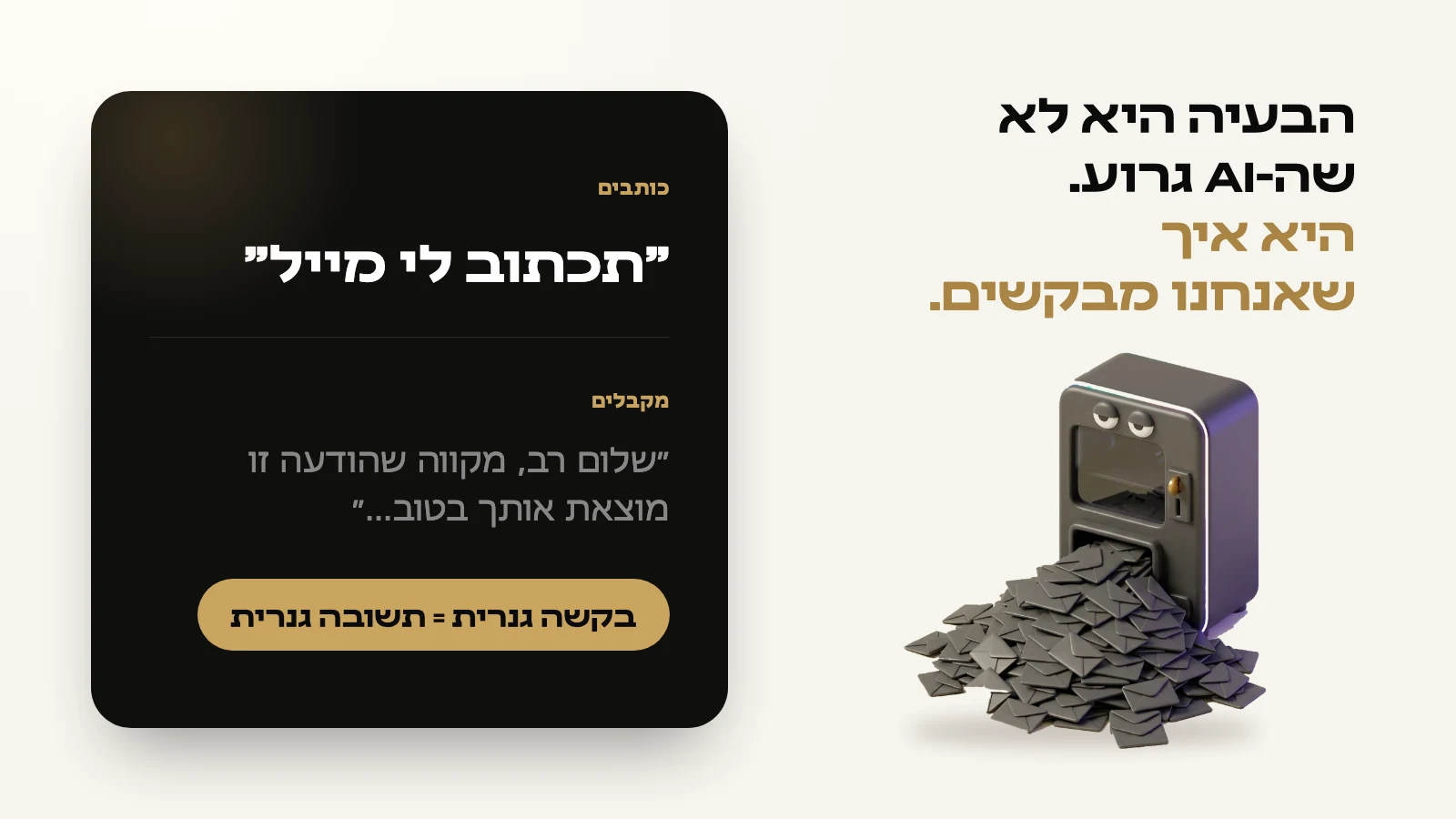
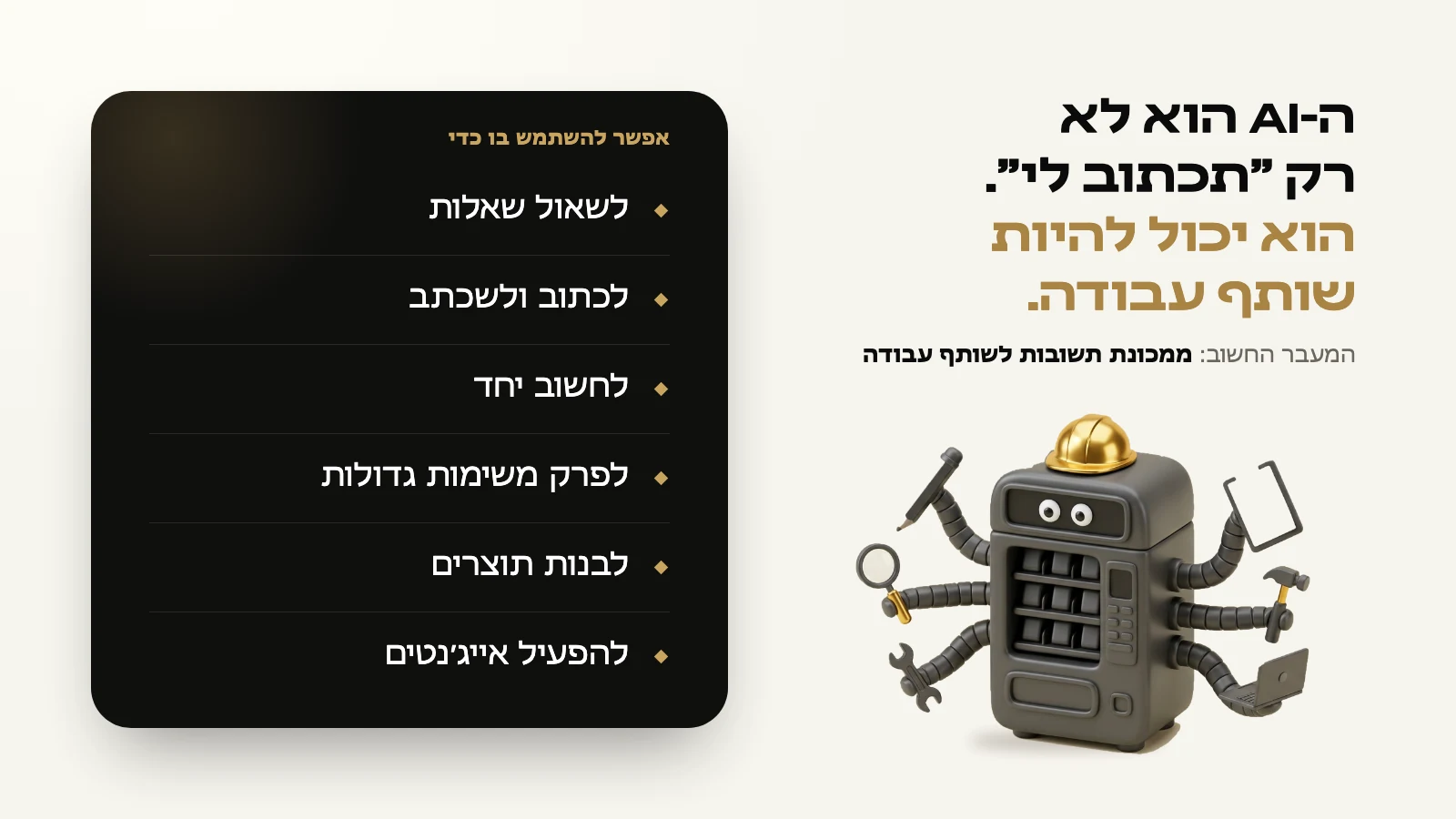
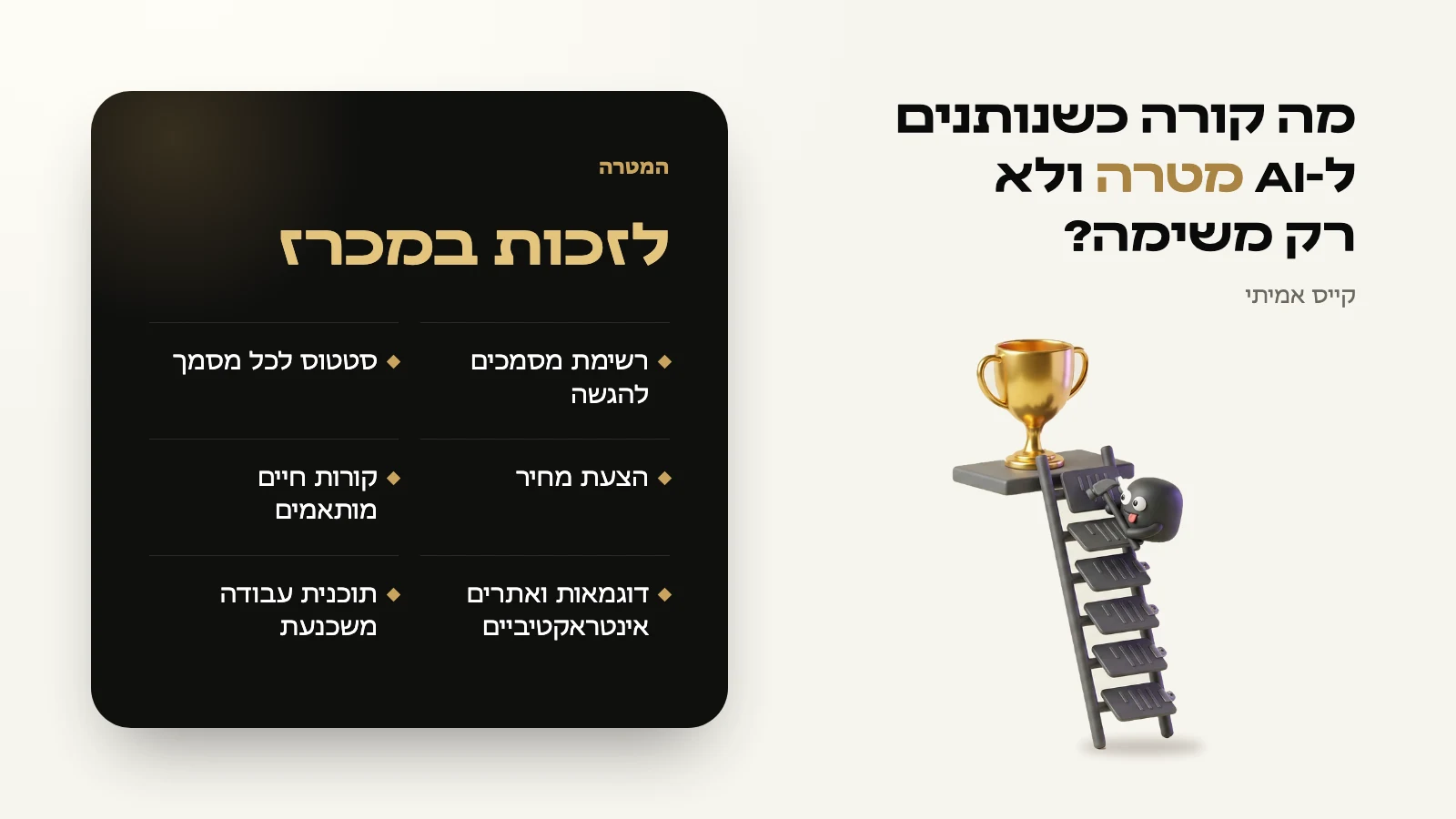
Elyakim:It's like walking into a chef's restaurant and telling the waiter "bring food", then being disappointed you got rice.
Elyakim:Most people use AI like Google with PR.
Elyakim:Instead of telling the AI "write me a proposal", I told it something else: my goal is to win this tender, find me a way.
An illustration of a session. The slides are from the Hebrew workshop, the lines are translated.
Who's behind this
Elyakim Goldfus, founder of Elyagol Studio, a UX/UI design and Webflow development studio.
He works with AI in the studio every day, agents included, so he teaches what he does himself.
They are built for Israeli teams, from people just starting out to people already working with AI. There is humor, and not one sentence about "the future is already here".

Three steps
Pick your workshop in the form.
Choose which workshop fits your team and what it should take away from it.
I read it and get back to you.
What you picked and what you wrote about your team reaches me, and I reply by email. If you'd rather talk, a 30-minute call is an option too.
We lock a date and you prepare.
You set the date, and you know what to do beforehand.
What you're probably asking yourself
Fair questions. Straight answers, including what I won't promise.
Didn't find yours? The form has a line for exactly that.If your team is just starting out, or still uses AI mostly as question and answer, start with "AI Without the Fumbling". If you already work with Claude or Codex on complex tasks and want an agent that works, it's "One Agent That Works". Not sure? Choose "Not sure yet, let's decide together" in the form.
There's something to build on. The question is how. Most people use AI like Google: a question, an answer, done. The workshop doesn't teach where to click. It teaches what to write, so the answer is one you can send without cringing. And if your team has already gone further, there's a second workshop: One Agent That Works.
If people leave with enthusiasm and no tools, probably yes. That's why "AI Without the Fumbling" ends with a task for the coming week, and you leave with a fixed way of writing requests that you come back to every time. In "One Agent That Works", every participant leaves with an agent that works on a task of their own. A cultural revolution after 90 minutes, I don't promise. Leaving with something in hand, yes.
Neither is the workshop. "AI Without the Fumbling" is built for teams at any level, and you don't need any technical background. "One Agent That Works" also has you write instructions in plain language, the way you'd write to a new employee, but it's meant for people who already work with AI.
It's part of "AI Without the Fumbling", briefly, as a responsible adult would. Before you upload something, you ask: is it personal information? A client's? Passwords? Medical or financial information? And the rule: if it would hurt to see it in the news, think twice. It's a rule of thumb for people, not a replacement for your organization's information policy.
And between us, you already have 90-minute meetings that end with "let's get back to this". Here you end with something in hand: a task for the week, or an agent that works.
The tools change, true. But what the workshops teach doesn't depend on the tool: how to write a request that gets a good answer, how to give feedback instead of "not good", and how to give an agent a job, rules and limits. You'll need that with the next version too.
A generic request gets a generic answer, and that goes for workshops too. In "AI Without the Fumbling" you see a bad prompt next to a good one, a follow-up to a client who went quiet and a tender, and you work on things like a procedure that lives only in one employee's head, what was promised to a customer and never reached the people who deliver, and customer feedback nobody has read. And "One Agent That Works" has no generic material at all, because every participant works on a task of their own. And whatever you write in the form about your team, I read.
"AI Without the Fumbling" is about how you talk to AI, not about a specific field, which is why it works for mixed teams. In "One Agent That Works" everyone works on their own job, so the content adapts itself. And if there's something specific about your team, the form has a line for exactly that.
There's plenty of good content there, and honestly you don't need me to hear what a prompt is. But a video doesn't wait for you to try, doesn't ask you questions, and doesn't make sure the whole team leaves with the same method. How many courses have you saved to "watch later", and how many did you finish?
"AI Without the Fumbling" builds the opposite picture. AI is a fast, confident intern, and someone has to manage it, check it and give it feedback. In "One Agent That Works", participants decide for themselves how much autonomy the agent gets, and what it must never do. The decision stays with you.
Build the workshop for your team
Choose which workshop fits your team and what it should take away from it. What you pick reaches me exactly as it is, and I get back to you with an answer, not a questionnaire.
The workshop you picked
Choose, and I'll show here exactly what gets sent.